
 PoEx001

|
Cavalry to the Rescue Polish Exiles #2 |
||
|---|---|---|
| (Attacker) Germany | vs |
France
(Defender)
Poland (Defender) |
| Formations Involved | ||
|---|---|---|
| France |  |
59e Division d'Infanterie Légère |
| Germany |  |
4th Panzer Division |
| Poland |  |
10th Armored Cavalry Brigade |

|


| Overall Rating, 3 votes |
|---|
|
3.33
|
| Scenario Rank: --- of 1093 |
| Parent Game | Polish Exiles |
|---|---|
| Historicity | Historical |
| Date | 1940-06-13 |
| Start Time | 00:13 |
| Turn Count | 18 |
| Visibility | Day |
| Counters | 124 |
| Net Morale | 0 |
| Net Initiative | 2 |
| Maps | 4: 27, 28, 31, 33 |
| Layout Dimensions | 86 x 56 cm 34 x 22 in |
| Play Bounty | 196 |
| AAR Bounty | 163 |
| Total Plays | 2 |
| Total AARs | 2 |
| Battle Types |
|---|
| Delaying Action |
| Exit the Battle Area |
| Inflict Enemy Casualties |
| Rear Guard |
| Road Control |
| Conditions |
|---|
| Randomly-drawn Aircraft |
| Reinforcements |
| Joint Forces Battle |
| Scenario Requirements & Playability | |
|---|---|
| Deluge | Counters |
| Fall of France 2 | Maps + Counters |
| Polish Exiles | Base Game |
| Introduction |
|---|
|
North of Sézanne, France The German Group von Kleist had broken through the French front on the Marne and rushed south in pursuit of the routed French units. The 4th Panzer Dvision spearheaded their drive toward Sézanne, Troyes and the Seine river. At around 1000, Battle Group Boineburg seized Montmirail, pushing aside elements of the 59th Light Infantry Division. The French, aided by a company from the 4th Tank Battalion, then tried desperately to halt the advance of the panzers and allow their dislocated units to withdraw, forming small defensive hedgehogs on the roads to Sézanne. At 1230, division commander Georges-Eugène-Joseph Lascroux moved his headquarters to the eastern exit of Les Essarts, but faced with an impressive tank push on Clos-le-Roi he moved on to Lachy. |
| Conclusion |
|---|
|
The 59th Light Infantry Division had been formed on May 30 by renaming the 17th Infantry Division, itself formed on May 21 from the remnants of the 55th and 71st Infantry Divisions shattered in the fighting along the Meuse. It comprised two infantry regiments, the 83rd and 135th, the 47th GRDI and the 84th Artillery Regiment with two groups of 75/97 horse-drawn guns. The 84th Artillery Regiment deployed at the edge of the forest and opened fire on the German columns, but the invaders continued to advance southward. A combination of 150mm artillery fire and air attacks destroyed most of the French guns; French infantry, pursued by tanks, fled in panic or were surrounded. The FCM36 tanks of the 4th Tank Battalion finally intervened, but ran into the 35th Panzer Regiment. The Germans opened fire at long range, quickly destroying two French tanks, but a series of four flank attacks by the 4th Battalion's company forced the Germans to retreat each time, enabling the French infantry and artillery to withdraw. Around 1300, Maczek received new orders from VII Corps to act as rearguard for the 20th and 59th Infantry Divisions retreating to the southeast. Maczek chanced upon the headquarters of the 59th Light infantry Division, on the very spot where Foch's 1914 offensive had begun. At 1600 the Polish brigade intervened to enable the French to withdraw to the southeast. But when Maczek's tanks reached their line of departure, a squadron of Hs123 biplanes appeared and the brigade lost a dozen vehicles, 12 dead and some 15 wounded. Once the planes had left, the Polish tanks deployed and went on the attack. Two companies made rapid progress and surprised a reconnaissance detachment supported by anti-tank gun. In the ensuing exchange of fire, the Poles put two armored cars out of action, but suffered damage to two R35's. In the end, the Polish brigade had no choice but to withdraw at around 1800. By evening, the 59th Light Infantry Division had all but ceased to exist. |
| Additional Notes |
|---|
|
Use French 25mm AT, 25CA, DRG, and R40 units to represent Polish units. There is a DIY countersheet for a Polish version of the French substitute counters. Counters from White Eagles may be used instead of those from The Deluge. |

|
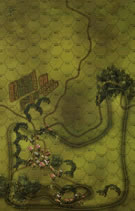
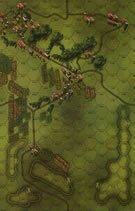
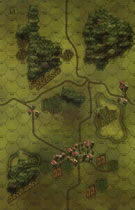
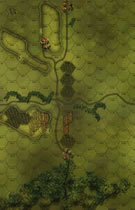
|
|---|
| AFV Rules Pertaining to this Scenario's Order of Battle |
|---|
|
| Armée de Terre |
|---|
|


| Heer |
|---|
|


| Wojska Lądowe |
|---|
|


| 4 Errata Items | |
|---|---|

|
In 1940: Fall of France, the units show Direct Fire. All units are Indirect Fire. (rerathbun
on 2015 Jun 06)
|

|
The reduced direct fire value of the Heer HMG became 5-5 starting with Fall of France. (plloyd1010
on 2015 Jul 31)
|

|
The morale and combat modifiers of German Sergeant #1614 should be "0", not "8". (Shad
on 2010 Dec 15)
|

|
All SPW 251s have an armor value of 0. (Shad
on 2010 Dec 15)
|
| Save the French, Stop the 4th Panzer! | ||||||||||||||
|---|---|---|---|---|---|---|---|---|---|---|---|---|---|---|
This was a 5-session with the tenacious & cunning Grognard Gunny leading attacking elements of the German 4th Panzer Division on 13 June 1940. I led defending elements of the reinforced, French 59th Light Infantry Division and the 1st Polish Armored Brigade. Both sides had decent leader draws. We played using the FOW, consolidation, hidden units (French only), strategic movement and excess initiative optional rules. Also used were this house rule: Standardized Movement for Mechanized Units — All mechanized units may move through clear hexes at a movement cost of only 1 movement point (MP) per hex, instead of 1 1/2. Add one to this cost if moving up, across, or down slopes hexes. During our first session (game turns 1-4) the German advance guard, led by armored cars, started south in 3 distinct columns leading a movement to contact from the north edge of Map 31. They were taken under fire by French AT gun platoons who managed to inflict 6 step loses on a pair of advancing Pz-Is and a very bold Pz-IVE unit. This resulted in the loss of a level of initiative for the Wehrmacht. However, the gun crew of the French AT gun on the ridge were demoralized and fled. Third Reich reinforcement formed a second attacking wave that entered the map in another three, separate columns, with flanking detachments on the far western & eastern margins of Map 31. The second session (game turns 5-6) consisted of the ongoing movement of the same 3 columns of German troops & armor in a southerly direction. In the west (right flank), the halftrack-borne, Landsers began encircling the westernmost 1-hex village. In the center, the Wehrmacht lost another pair of steps to accurate French AT fire, but also eliminated the last of the defending AT gun platoons, who abandoned their guns & fled. Just east of center (left flank), German armor closed to decisive range of the remaining French garrison in the 2-hex town on Map 31. Supporting reserves of German infantrymen moved slowly forward in both the center and left flank. Our third session (game turns 7-9) featured the slow closing of the German claws around the northernmost French villages on Map 31, where another 4 steps of French units were eliminated in adjacent hex firefights and close assaults. Some long-range French AT fire managed to destroy a German SPW in Hex 31-0310. French initiative fell one level this session, and their reinforcements were delayed as the Germans slowly pushed south. The fourth session (game turns 10-12) featured successful German close assaults in both small villages on Map 31, causing the loss of 2 French leaders and a pair of steps, which included the last of the French mortar platoons. Three more German steps were lost to accurate AT fire from dug-in, or town-defending French tanks, thereby bringing the step loss tally to: 12 for the Germans, and 10 for the French. The reinforcing Poles began entering the eastern margin of the battle map during the 12th game turn, moving diagonally to the northwest on Map 27. Our fifth & final session (game turns 13-17) was rather grim for the attacking Wehrmacht force with an additional 4 step losses - all were Pz-I light tanks - that were caught by charging Polish tanks in the northern sector of Map 27. Between the stolid French defenders and the newly introduced Poles, the Germans had to pull back and were stymied be several prematurely ended game turns. My honorable opponent chose to concede at the start of the game turn 17, when it was apparent that the French & Poles had won a major victory. The final step loss tally was: 18 for the Germans, and 11 for the Allies. There were 9 FOW-shortened turns of the 17 played. This was another gamey, but relatively fun-to-play & interesting scenario. Against a challenging opponent, it is a decent SHARED play option that I think merits a 4, with the caveat that the more experienced player should lead the Teutonic invaders as their victory conditions are not easy to achieve. As published, it is probably more suitable for SOLO play. |
||||||||||||||
| 0 Comments |

| Got stuck in the woods again! | ||||||||||||||
|---|---|---|---|---|---|---|---|---|---|---|---|---|---|---|
The offensive started out all right, but got stuck in the Southern portions of the forest by a couple of VERY stubborn AT guns. This set the attack back a few turns at which time the German Commander pretty much decided that it was a lost cause, considering the shortness of the scenario but (knowing the Fuhrer's resistance toward retreat), decided to keep on trying to no avail. After putting on a good show for the "honor" (you know) the Germans surrendered just short of the finish. (Note - This scenario is pretty well matched and is good for shared play.) |
||||||||||||||
| 0 Comments |