
 34BP002


|


| Overall Rating, 3 votes |
|---|
|
4.33
|
| Scenario Rank: --- of 1093 |
| Parent Game | Bron Pancerna |
|---|---|
| Historicity | Alt-History |
| Date | 1940-09-03 |
| Start Time | 06:00 |
| Turn Count | 32 |
| Visibility | Day |
| Counters | 175 |
| Net Morale | 0 |
| Net Initiative | 0 |
| Maps | 6: 1, 3, 4, 5, 6, 7 |
| Layout Dimensions | 86 x 84 cm 34 x 33 in |
| Play Bounty | 222 |
| AAR Bounty | 163 |
| Total Plays | 2 |
| Total AARs | 2 |
| Battle Types |
|---|
| Bridge Control |
| Inflict Enemy Casualties |
| Conditions |
|---|
| Off-board Artillery |
| Scenario Requirements & Playability | |
|---|---|
| Bron Pancerna | Base Game |
| Deluge | Counters |
| Fall of France 1 | Counters |
| Fire in the Steppe | Maps + Counters |
| Introduction |
|---|
|
While some armies believed that tanks should attack enemy infantry, and enemy tanks should be defeated by anti-tank guns, the Polish Army intended for its own tanks to counter enemy tanks. Polish divisions wielded anti-tank guns to fend off tanks, but then Polish tanks would finish them. That rarely happened in 1939, as Poland had very few tanks, but a strong Polish armored force would have sought out the panzers. |
| Conclusion |
|---|
|
The Polish 14TP, which likely would have weighed in at about half again as much as its stated 14 tons, would have been an outstanding tank, superior to anything in the German inventory in the fall of 1940 (when it would have entered service with the Polish Army). Crewed by Poles defending their country from its ancient enemy, it would have been a deadly opponent. |
| Additional Notes |
|---|
|
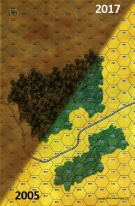
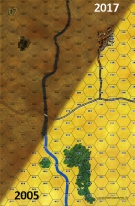
Full strength Polish INF units have a direct fire value of 6-3. Piechoty (infantry) counters have been created for those players who are willing to make their own counters to reflect this counter variant. Counters from White Eagles and Eastern Front Deluxe may be used in place of those from The Deluge and Fire in the Steppe. |

|
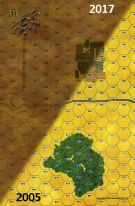
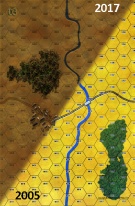
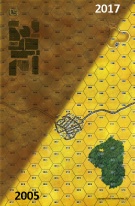
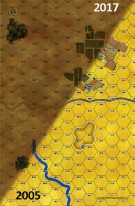
|
|---|
| AFV Rules Pertaining to this Scenario's Order of Battle |
|---|
|
| Heer |
|---|
|


| Wojska Lądowe |
|---|
|


| 3 Errata Items | |
|---|---|

|
The reduced direct fire value of the Heer HMG became 5-5 starting with Fall of France. (plloyd1010
on 2015 Jul 31)
|

|
One unit from Eastern Front has a direct firepower of 3-5 on its reduced side instead of the normal 4-5 (garbare83686
on 2023 Nov 26)
|

|
The morale and combat modifiers of German Sergeant #1614 should be "0", not "8". (Shad
on 2010 Dec 15)
|
| Slow & Stop the Onrushing Germans! | ||||||||||||||
|---|---|---|---|---|---|---|---|---|---|---|---|---|---|---|
This was a 10-session play through with the intrepid & adaptable NBGB leading elements of the invading German 7th Panzer Division in a meeting engagement on the Polish plains. The Wehrmacht columns approached from the west edge of the 6-board, battle map. I led defending elements of the legendary, Krakow Mechanized Infantry Brigade in what turned into a free-wheeling, fast-paced scenario. Both sides had fine leader draws, with the Poles having a slight advantage. We played using the FOW (starting on game turn 8), consolidation, smoke/illum, hidden units (Poles) excess initiative, strategic movement and extended assault optional rules. In addition, we used these 4 house rules: 1) Road Movement for Mechanized & Foot Units - All FOOT & MECHANIZED units may move on roads at the rate of 1/2 of a Movement Point (MP) per road hex, just like MOTORIZED units, 2) Standardized Movement for Mechanized Units — All mechanized units may move through clear hexes at a movement cost of only 1 movement point (MP) per hex, instead of 1 1/2. Add one to this cost if moving up, across, or down slopes hexes, 3) Armored Fighting Vehicle (AFV) Consolidation - Unless prohibited by special scenario rules, half-strength (reduced) AFV units of the same type, nationality and morale condition may be combined to form a single full-strength unit. Both reduced units must start their activation in the same hex and be activated by an adjacent – or same-hex – good order, Tank Leader. This action costs both units all their movement points. Remove one of the units, flip the other to its full-strength side and mark it activated, and 4) Enhanced Anti-Tank (AT) Gunnery & Hidden Emplacement - Unless prohibited by special scenario rules, ALL dug-in, entrenched, or town-occupying, towed AT gun units and Self-Propelled AT guns may fire in opportunity fire (OPFIRE) TWICE just like tanks in the standard rule set. For example, dug-in, German PaK 36 (37mm); PaK 38 (50mm); or British 6-pdr towed AT gun platoons are therefore able to fire TWO AT shots per unit in OPFIRE situations. In addition, towed, or self-propelled, AT guns always begin scenarios in HIDDEN mode if allowed to dig-in per scenario special rules, or are entrenched, and/or town-occupying (please see Optional Rules for Hidden Units; Plotting Position; Revealing; and No Hidden Units Specified, on Page 37). This set of optional rules served very well in this long fight and improved playability! Our busy, first session (game turns 1-2) featured a flawless, German movement to contact using a partially covered & concealed approach in the southwest corner of Map 01. My distinguished opponent again selected to use his famous, right-handed fiddler crab advance. Nearly 2 full battalions of Landser infantry flanked by armored cars and motorcycle infantry moved into the large forest. Unexpectedly, the Poles had the initiative during the first pair of game turns. They used this slight advantage to advance their scouting elements and 3 companies of light tanks in a bold move across the river to occupy both the 7-hex town on Map 04, and the 5-hex town on Map 03. The victory point tally was now 10 for the Poles – who control both bridge hexes. Surprisingly, no casualties were sustained by either side. The second session (game turns 3-5) featured the Germans massing in the southern forest on Map 01, prior to them beginning a strong right flank attack on the Poles. The terminal German push to cross the river opposite the Polish-held southern forest on Map 07, included 2 game turns of well-deployed, heavy smoke screens to mask opfire from the Poles. First blood was drawn by the Poles and this session was marked by 4 Wehrmacht step losses, plus a leader captured. The Poles lost a step and their best officer in a ferocious close assault in hex 07-0514. The leading Germans crossed the minor river (Hex 07-0613) during game turn 5. Our action-packed, third session (game turns 6-7) included several adjacent hex firefights and three ferocious close assaults, as the Germans slowly forced their way across the river. The first Polish tank step was lost in a close assault on the defender’s side of the river near the southernmost bridge, where a second Wehrmacht officer was also eliminated. The updated victory point tally was now:17 for the Polish defenders, and 6 for the German attackers. The costly fourth session (game turn 8) featured the Poles trying to contain the advancing Germans in and around the contested bridge head at Hex 07-0509. There was a great deal of close assault and adjacent-hex firefighting in the southern half of Map 07, which resulted in a combined 13 step losses! As a result, the contending sides, each lost a level of initiative as casualties accumulated. The bulk of the Wehrmacht armor finally deployed in an amorphous mass, west of the river as the second echelon of what-has-become a broad-front, moving blitzkrieg. Both sides’ morale recovery and infantry combat die rolls were generally poor this session, but Polish anti-tank & direct fire proved unexpectedly accurate. Our exciting & momentous fourth session (game turns 9-10) featured the full commitment of German armor to crossing the middle portion of the river under a well-placed smokescreen, as well as continued stalemate in the southern sector adjacent to the woods on Map 7. The Germans lost a couple of steps, plus a leader, while the Poles lost an extra four. The next 2 turns may prove decisive. The fast-moving & costly, fifth session (game turns 11-13) featured many long-range AT shots, some remarkable OBA strikes and heavy fighting around the southern bridge, where the Poles foolishly attempted a bayonet charge. Step losses this session totaled: 8 and a leader for the scrambling Polish defenders, and 13, plus a leader, for the relentless Germans. The contested bridge hex belonged to the Wehrmacht by the middle of game turn 13, while 7 platoons of German armor scuttled east and out of range, concentrating near the 20-meter hill on Map 05. The remaining steps of German armored cars were eliminated by a Polish tank company that had circled behind the advancing wave of Germans. Both sides dropped initiative levels this session, and the updated steps losses stood at: 20 for Poland, and 30 for Germany. At this point, the southern woods remaining in Polish hands, but the plain directly north was now heavily contested with the Poles massing for a combined arms, counter attack. Our action-packed, sixth session (game turns 14-17) featured fierce fighting and a combined 12 steps lost, mostly by the Poles, plus the capture of two more German leaders. This session may prove decisive in the end, as the Polish counterattack against the German foothold, on and around the southern bridge hex collapsed, almost as fast as it was mounted. This resulted in a decline in the Poles’ initiative level as well. Heavy adjacent-hex firefights, effective German OBA, and a pair of close assaults yielded significant Polish infantry casualties that took the starch out of their combined arms, counter offensive. Elsewhere on the battle field, long-range AT fire by the opposing tank formations was the order of the day, and both sides scored some minor successes as they jockeyed for advantage. The very costly, seventh session (game turns 18-21) featured intense fighting in the vicinity of the southern bridge and some remarkable artillery, long-range AT shots and close assault luck for either side. Step losses this session totaled: 9 for the Wehrmacht and 6 for the revitalized Poles – a combined 25 steps. Highlights included a German assault against a lone tank platoon broken up by a “a danger close” artillery mission, and a pair of lethal adjacent-hex firefights just north of the south bridge. The updated Victory Points were 38 for the Third Reich boys and 48 for the defending Poles. Our wild & wooly, eighth session (game turns 22-25) was characterized by very heavy fighting, in and around the contested bridgehead, that resulted in step losses of 9 for the Germans (plus 2 leaders) and 6 for the embattled Poles (plus one leader)! Both sides were now at zero initiative due to high casualties, and the victory points were at: 57 for the Poles and 44 for the Wehrmacht. Oddly, there was very little armor maneuvering this session primarily due to the large number of morale recoveries that were required by multiple close assaults and adjacent-hex firefights. The contending forces were running out of infantry units as the battle approached its climax. The stimulating ninth session (game turns 26-29) featured continued heavy fighting in & around both the contested bridge hexes with the Germans tenaciously maintaining their bridgehead in the southern one. There was a fair amount of armored unit movement as well, along with multiple adjacent hex firefights and close assaults. Step losses this session were another 5 for the Poles and a leader, as well as 2 more for the Germans, plus a leader. The Polish side initially drove off an armored assault in the south woods but were then surprised by another on the western margin of the same forest. The updated steps loss tally was now at: 39 for the Poles and 59 for the Germans. Plus, a combined 13 leader casualties: 4 Polish & 9 German. Our costly. tenth & final session (game turns 30-32) consisted of more intense combat, but the Poles eventually reclaimed sole control of the two bridges by the end of game turn 31. This development came at a very stiff cost of another 10 Polish steps, while the Wehrmacht lost 12 more in heavy fighting, as well as a leader. My gracious opponent called the gams as a major Polish victory at the start of the 32nd gam turn, when it was clear that there was no way to overcome the Polies. The final victory point total was: 81 for the resolute Poles, and 54 for the Germans. A mighty, hard-fought battle from start to finish, in which the Third Reich lost 10 leaders! There were 16 FOW-shortened turns of the 32 played. This was a fun-to-play, but overlong scenario. I give this action-filled, scenario, an enthusiastic 5 in shared play, noting that it would normally merit a solid 4, in the absence of an able & experienced opponent. IMHO, the more experienced player should lead the Polish side, and the length of the scenario should be reduced to about 26 or so game turns. Though obviously not properly play tested, it is entertaining & easily manageable in SHARED play. |
||||||||||||||
| 0 Comments |

| Best Defense is a Good Offense |
|---|
|
Each scenario so far has introduced new armored forces on both sides to fight with and scenario #3 is no different, the Polish forces get the 14TP, armor 4 (4-7 AT) and 10TP, armor 2 (3-4 AT) up against the German Czech built Pz38. Just like the previous battles the S35 is included in the Polish OOB. This battle is another contested river crossing, similar to scenario #2 but with 6 maps and two bridges that are worth 5 VP each for control of at the end of the game. The Germans have a large motorized infantry force with artillery and armor support, while the smaller Polish infantry is deployed to defend the two bridges. Unlike the previous scenario the Polish armor sets up on the map instead of entering the battle as reinforcements and deployed between the two bridges so they could quickly reinforce either bridge. As soon as the German forces were spotted heading for the north bridge the Polish armor decided to cross the river for a spoiling attack on the right flank of the German formation, hoping to catch their infantry still in their trucks, but they would have to get thru the German panzers first. The German Pz38s concentrated on the Polish 14TP tanks hoping to knock them out quickly since they were the best tank on the battlefield, the Germans sent one company on a flanking maneuver to set up cross fire to get the +2 bonus on the AT table. The tank battle initially started out well for the Germans, their flanking company did their job but these were the Pz38A’s with only 2 armor, they did not survive long as the pendulum of battle swung towards the Polish tank forces. They did succeed at eliminating a company of the 14TP’s as well as reducing several S35 platoons with the help of the Pak 36’s, but it came at a high price, a full battalion of Pz38’s were knocked out with one lone company and the towed PaK 36s were all that was left to oppose the Polish armor. After the German infantry took the bridge and cleared the woods they did not have the armor strength to head south for the other objective and the Polish armor without infantry support was not in the mood to recapture the bridge. At the end of the battle the Polish forces had eliminated more enemy steps, with tank steps counting double the VP or 4 points per platoon, the eliminated Pz38’s more than made up for the Polish infantry losses. Good scenario, the armor battle looked like it might go to Germans, then the Polish forces dice got hot. The German infantry bent but did not break, while their leaders and OBA kept them in the game. |
| 0 Comments |